Indochina
The Day of the JackalIndochina is more than a posting in Marc Rodin’s career: it is the theater in which combat becomes both his route to advancement and the foundation of his political grievance. The novel links his years there, among soldiers he regarded as his own kind, to a conviction that France had betrayed its army—a conviction that would carry him from colonial service into the rebellion against Charles de Gaulle and, later, the OAS.
A Theater of Advancement
Rodin reached Indochina after a career shaped by exclusion from the usual routes to promotion. The son of a cobbler, he had risen through the ranks during the Second World War and received a field commission during the fight for Paris, but his lack of formal education left him resentful as graduates of officer schools advanced past him. The colonial regiments offered a different measure of worth: their soldiers fought, and combat could still open a path upward. Rodin secured a transfer to the colonial paratroops.
Within a year in Indochina, he had become a company commander. The book presents the posting as a place where the prospects denied him by class and education seemed attainable through action and endurance. By the end of the campaign, he had reached the rank of major. That progress was real, but it was bound to the experience of war rather than to a stable professional future: after a frustrating year back in France, he was sent to Algeria.
Combat and the Formation of Belief
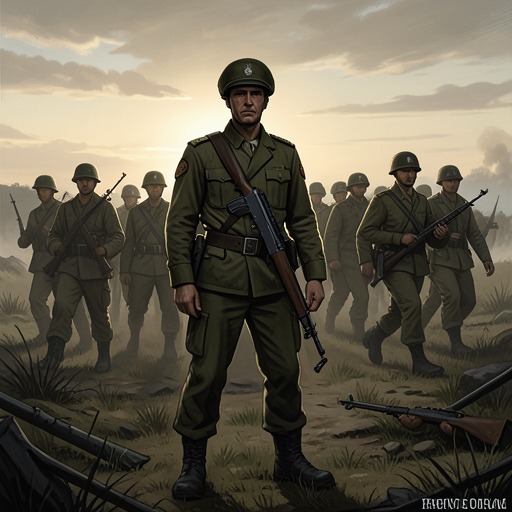
The narrative describes Rodin spending eight years in combat in the forests of Indochina. He saw men die and, at times, buried the mutilated bodies of those who had been captured alive. These experiences deepened his reverence for soldiers, whom he regarded as people who sacrificed themselves in blood while civilians lived in comfort. The distinction he drew between soldiers and civilians was therefore not abstract: it came from the unequal burdens he believed each group bore.
Rodin also interpreted criticism of the military through this divide. He resented left-wing intellectuals’ denunciations of soldiers for abuses such as torturing prisoners to obtain information, and came to treat civilian indifference to the army as evidence of a broader betrayal. His convictions were presented as his own interpretation, not as a neutral account of the war. In his view, France could have defeated the Viet-Minh if the authorities and the public had supported the army sufficiently. The withdrawal from Indochina consequently meant more to him than the end of a campaign: it signified that the deaths of the soldiers he honored had been rendered meaningless by political retreat.
From Withdrawal to Algeria
The French withdrawal and Rodin’s subsequent year in France transformed his existing resentment into what the narrative calls a consuming hatred of politicians and Communists, whom he regarded as effectively the same. He concluded that only rule by a soldier could free France from the political forces he blamed for its weakness. The book makes Indochina a decisive precedent in this reasoning: Rodin carried the belief that the army had been denied victory there into his next posting and treated Algeria as an opportunity to prove that another abandonment would not be allowed.
He left Marseille for Algeria in the spring of 1956, convinced that the army’s standing in the world could be vindicated there. In his eyes, Indochina had established the danger of political withdrawal; Algeria would test whether France would finally give its soldiers the backing he believed they deserved. The failure of that hope would deepen his opposition to the government. Indochina thus functions as the first loss in the personal history through which Rodin interprets subsequent events, rather than as a setting treated independently of his political development.
A Legacy in the OAS
Rodin’s connection to Indochina also shaped his later place in the OAS. The novel notes that he developed practical intelligence outside formal education and presents his military experience as part of the background to his organizational ability. When he became deputy to Antoine Argoud as operations chief in exile, Rodin supplied organization, cunning, and practical judgment, in contrast to Argoud’s flair and inspiration. His capacity to concentrate logically on practical problems made him more than a conventional fanatic, even though his political convictions remained rigid.
The theater’s continuing presence is clearest in the men Rodin retained during the collapse of the 1961 putsch. One hundred and twenty of his officers, non-commissioned officers, and rankers stayed with him; his unit had a higher proportion of veterans from Indochina and the Algerian countryside than most. Those survivors joined the Secret Army Organisation with the other putschists. The earlier campaign therefore persists not only as Rodin’s grievance but as a source of military identity and cohesion among the men who followed him into exile and renewed conflict. Indochina’s narrative significance lies in this chain of consequences: combat gives Rodin advancement, withdrawal gives him a language of betrayal, and that remembered defeat helps shape the anti-government organization he later serves.